
FarmGate.
Farmer records and services for basic phones. In development.
Separate programmes and records
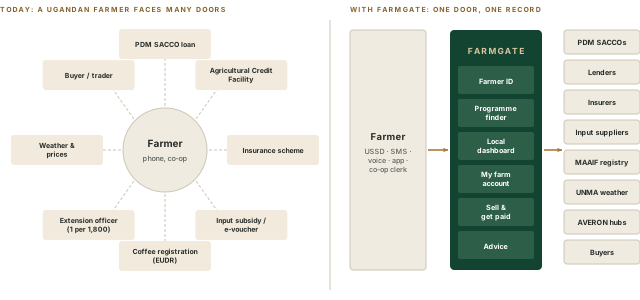
FarmGate is being developed to help farmers find support programmes and manage farm records through basic phones, with assistance from cooperative clerks.
The Parish Development Model has reached 3.57 million people through 10,589 parish SACCOs.51 The Agricultural Credit Facility has UGX 818 billion available,69 but close to half of applications are rejected.70 About 1 million farmers have crop insurance against a target of 3 million.71 Coffee farms must be mapped for EU rules.72 There is one extension worker for about every 1,800 farmers,52 and one study counted 32 separate digital platforms serving parts of the value chain.73
What we learned from farmers.gov
The US Department of Agriculture built farmers.gov after a listening tour of 35 states, joining seven digital platforms and 150 web resources into one site.67 It gives farmers plain-language guides, tools that tell them what they qualify for, a local dashboard and an account to see their loans and records.50 Visits grew from 227,117 in 2018 to more than 800,000 in 2019.49
FarmGate is being designed for basic phones and assisted use. In Teso, 32.8% of people aged ten and over own a phone and 4.3% use the internet,3 so the proposed services prioritise USSD, SMS and voice, with cooperative clerks assisting farmers.
Planned FarmGate services
| Service | What it does |
|---|---|
| Farmer ID and consent | One ID per farmer, linked to the cooperative, a mobile-money number and mapped plots. The farmer agrees what is shared and with whom. |
| Programme finder | Short questions by USSD, voice or clerk match the farmer to credit, insurance, input programmes, irrigation grants and coffee registration, with the next step and the nearest place to go. |
| Local dashboard | Sub-county prices for maize, beans, soybean, sunflower, sesame and coffee; seasonal forecasts and alerts; planting calendar; cooperative, hub and extension contacts. |
| My farm account | Inputs received on credit, deliveries, grades, payments and credit limit, sent as a monthly SMS statement. |
| Sell and get paid | Book a delivery slot at an AVERON hub, see the day’s price and be paid by mobile money with credit deducted. |
| Advice and alerts | Crop guides and voice messages in Ateso, Luganda, Luo and other local languages; pest, weather and price alerts. |
| Report a loss | Report drought, flood or pest damage with a photo or a clerk visit, to support insurance claims and advice. |
| Find a place | Nearest cooperative bulking centre, AVERON hub, SACCO, district agricultural office and verified agro-dealer. |
| Traceability | Plot maps and delivery records that support EU deforestation-rule evidence for coffee and other buyers. |
A farmer's season
Register
A cooperative clerk enrols the farmer and maps the plot.
Find support
The programme finder matches credit, insurance and input programmes.
Grow
Inputs on credit, advice by SMS and voice, weather alerts.
Sell
Book a delivery; the crop is weighed and graded at the hub.
Get paid
Mobile money, credit deducted, statement by SMS.
Grow again
The record supports applications for further credit and insurance.
Design principles
- Phone firstUSSD menus, SMS and voice come first; the web portal serves cooperatives, staff and partners.
- Assisted by people the farmer trustsCooperative clerks and village advisers register farmers, map plots and use the finder with them.
- In the farmer's languageAteso first for Teso, then Luganda, Luo and others; voice for those who do not read.
- Works offlineThe agent app stores data and syncs when there is signal.
- The farmer owns the recordClear consent for every use and every partner, under Uganda's Data Protection and Privacy Act, 2019.
- Connect, don't competeRefer farmers into existing government and insurance schemes instead of building parallel registers.
Pilot
A pilot is planned with DMI cooperatives in Kaberamaido, DMI's largest district: 11 cooperatives and 8,282 member farmers.65 It starts with discovery: interviews and group sessions with farmers, clerks and cooperative leaders, women and youth included. Each later stage starts only when farmers are using the one before.